AmazonVision · endorsed direction
Hiring Hub AI Companion
Setting the product vision for how AI supports hiring managers across the entire experience, from screening to evaluation to offer, without ever making the call for them.
Hiring Hub is the single place Amazon’s hiring managers go to run a hire, from opening a role to screening candidates, deciding, and making the offer. It brought tools that used to be scattered into one experience. The next question was harder: once everything is in one place, how does AI actually help a manager get through it, without quietly taking over the decisions that should stay human? I led the UX vision for that answer.
This is a vision, not a shipped product. I’m flagging that up front because it changes what to look for. There are no adoption numbers to point to. The work here is the thinking: the interaction model, the decisions behind it, the boundaries I set on what AI should and shouldn’t do, and how I defined success before a line of it was built.
The context
Hiring is only one of many things competing for a hiring manager’s attention on any given day. Even after Hiring Hub consolidated the tools, the insights and evidence a manager needed didn’t always meet them in the moment. They were still piecing the picture together themselves: reading each candidate profile, hunting down internal data, assembling the story before they could even start thinking about the decision.
To ground the work, we followed one hiring manager, Priya, through her day. Her pain point framed the whole vision:
Hiring is only one of many things competing for my attention. Hiring Hub brings my work together, but the AI support still feels fragmented. I have to find the right information, interpret different signals, and connect the dots myself to make a decision. The information is there. What’s missing is something that understands my context, brings the right signals together, and helps me move forward. Priya, hiring manager (composite persona from research)
So the team asked a simple question. What if AI became the through-line across the entire hiring experience, not a new destination, and not a replacement for what already works?
How I worked
I led the UX vision and presented it to leadership. This was a tiger-team effort, four of us, working with product, science, and engineering partners, and I was the designer shaping and telling the story.
- 01Frame the problemTurned a broad "where does AI go next?" into a clear question: how do we help managers decide with more confidence?
- 02Find the pain pointsPulled the moments of heaviest load from research and product data, and reviewed them with product and engineering partners.
- 03Shape the solutionRan design workshops with design and product, then narrowed to the dual-panel model and the moments worth showing.
- 04Prototype & alignBuilt the end-to-end prototype, walked leadership through it, and defined how we’d measure whether it worked.
The idea: a companion, not a tool that decides
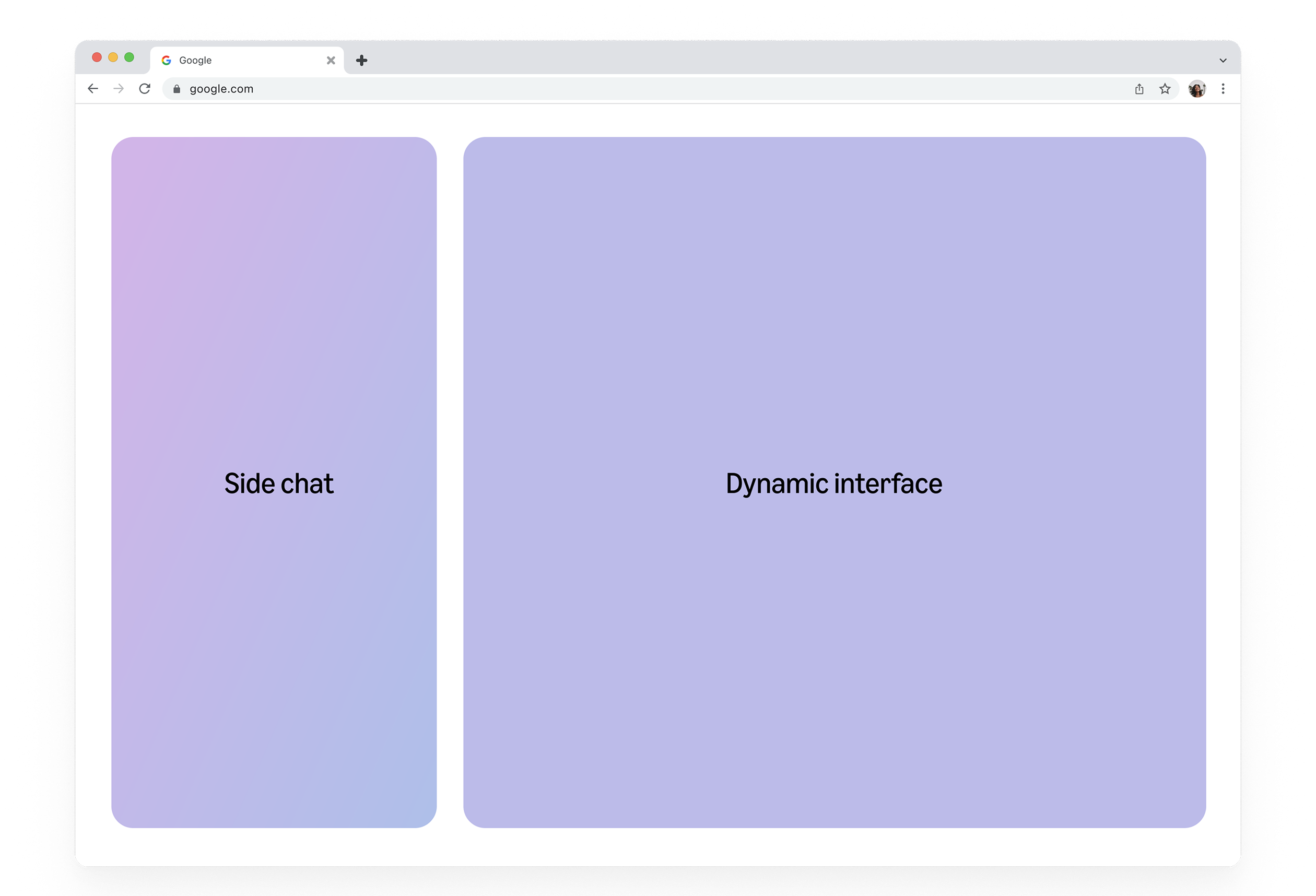
The vision is a dual-panel companion experience that does three things at every step: surface what matters, connect the evidence behind it, and bring the right action into the task at hand.
- On the left, a side chat. Where the hiring manager asks questions, gets summaries, and works with the companion in their own words. Context carries across every task, so they never have to repeat themselves.
- On the right, a dynamic interface. It adapts to the task in front of them, whether that’s a list of recommended candidates, a candidate deep-dive, or a debrief view, and brings forward the right information for that moment.
Both sides support reviewing information and acting on it. The manager can ask in the chat and collaborate with the companion, or take actions directly in the interface. Either way, it’s one flow.
We chose this model deliberately. Hiring decisions depend on context, evidence, and judgment, which a single fixed screen can’t flex to. A companion that reshapes around the task can.
The vision: AI across the hiring manager’s journey
The companion isn’t one feature. It’s a single behavior repeating at every stage where a hiring manager’s load is heaviest and today’s experience leaves them on their own. At each of these moments our research and product data flagged a real gap, and each became an opportunity for the companion to do the same three things: surface what matters, connect the evidence behind it, and leave the decision with the human.
Here’s the vision stage by stage, told through Priya, a busy hiring manager, starting at the front door of the journey.
Job creation
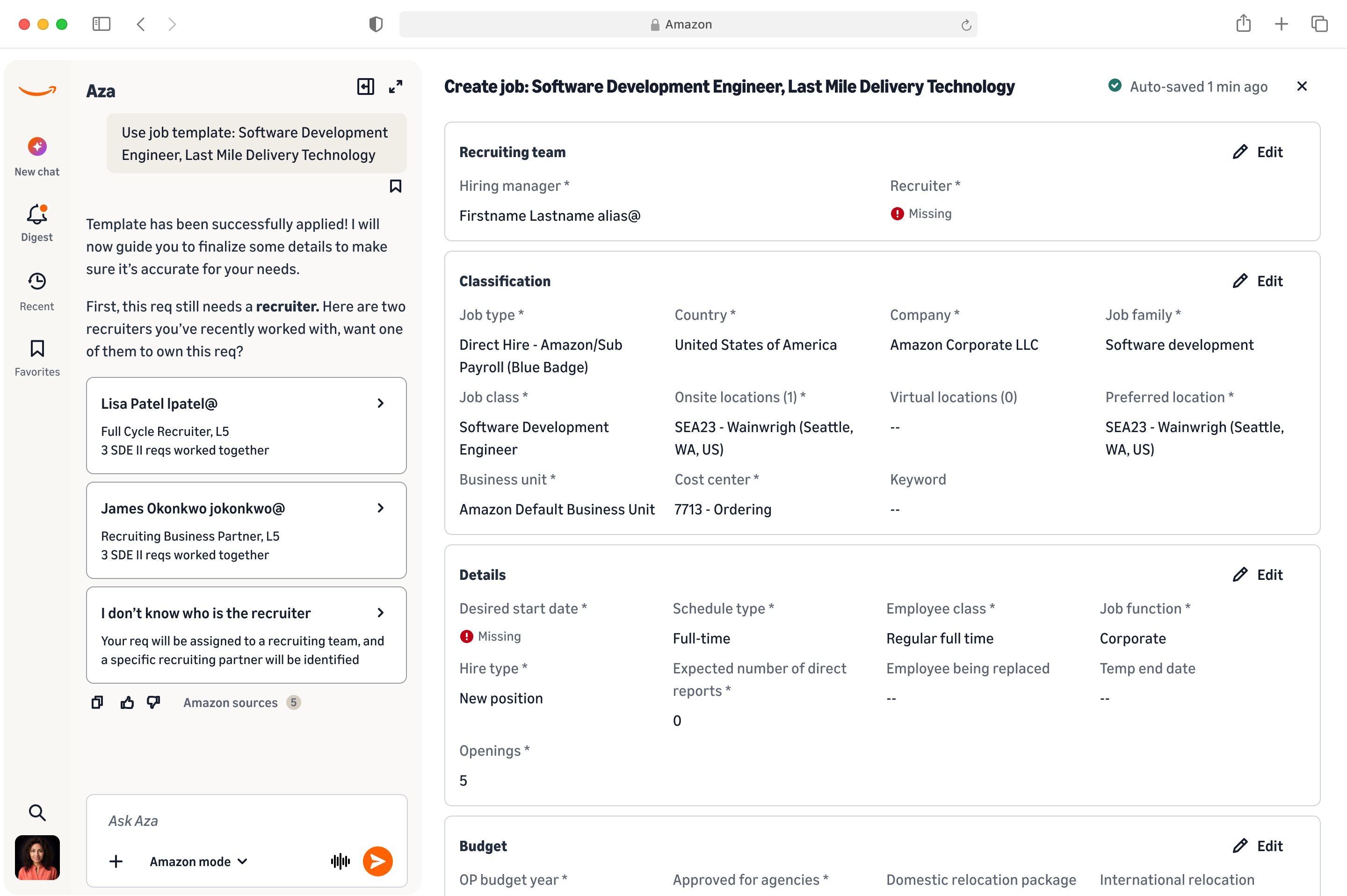
The journey begins when Priya opens the role and defines what she’s hiring for. That early intent is what every later stage inherits: the competencies to screen for, the questions to ask, the bar to hold at the debrief. Today it’s easy to leave vague, and every later decision pays for it. The companion helps her shape a sharp, specific role definition up front, so the rest of the journey starts pointed in the right direction.
Screening candidates
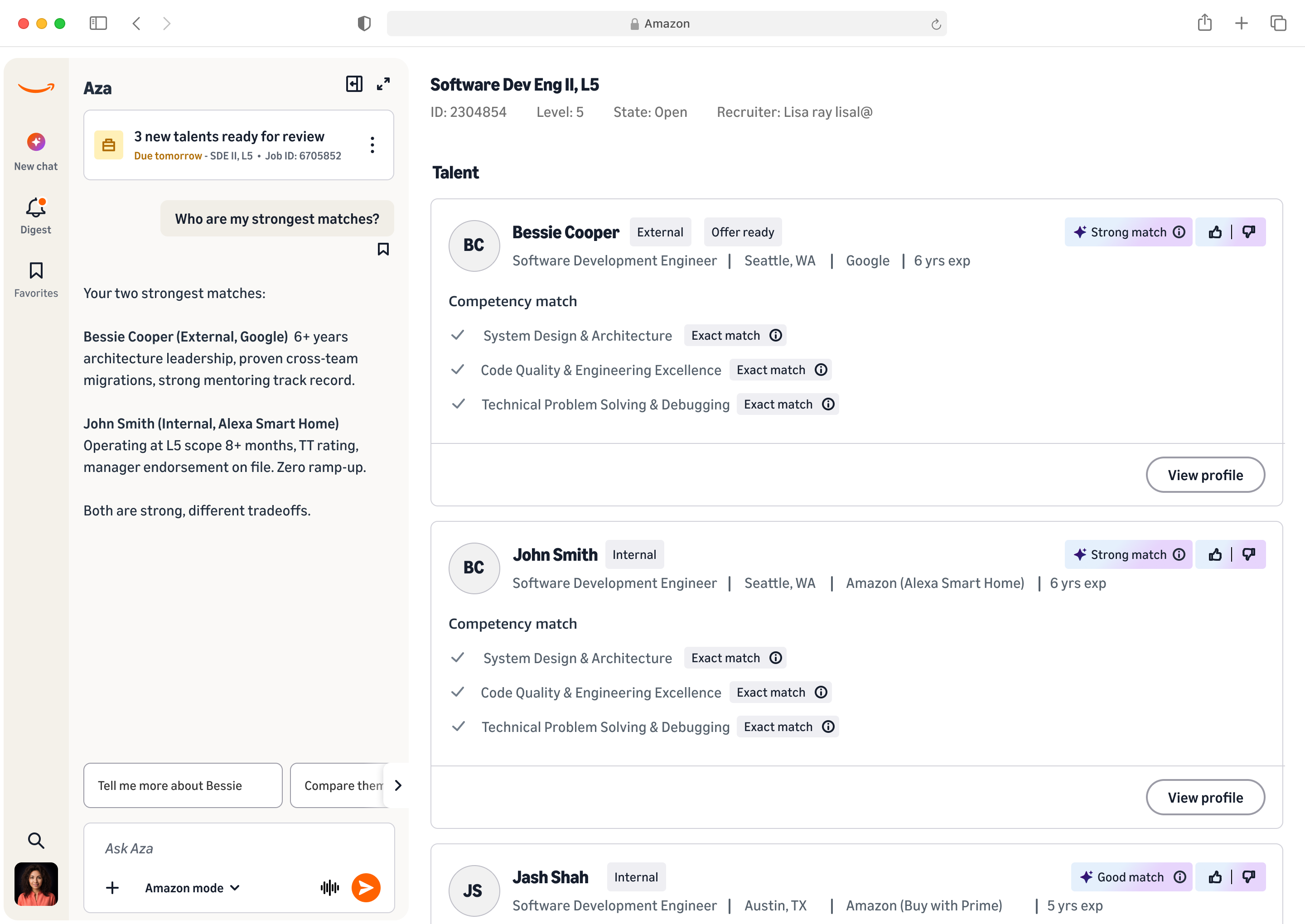
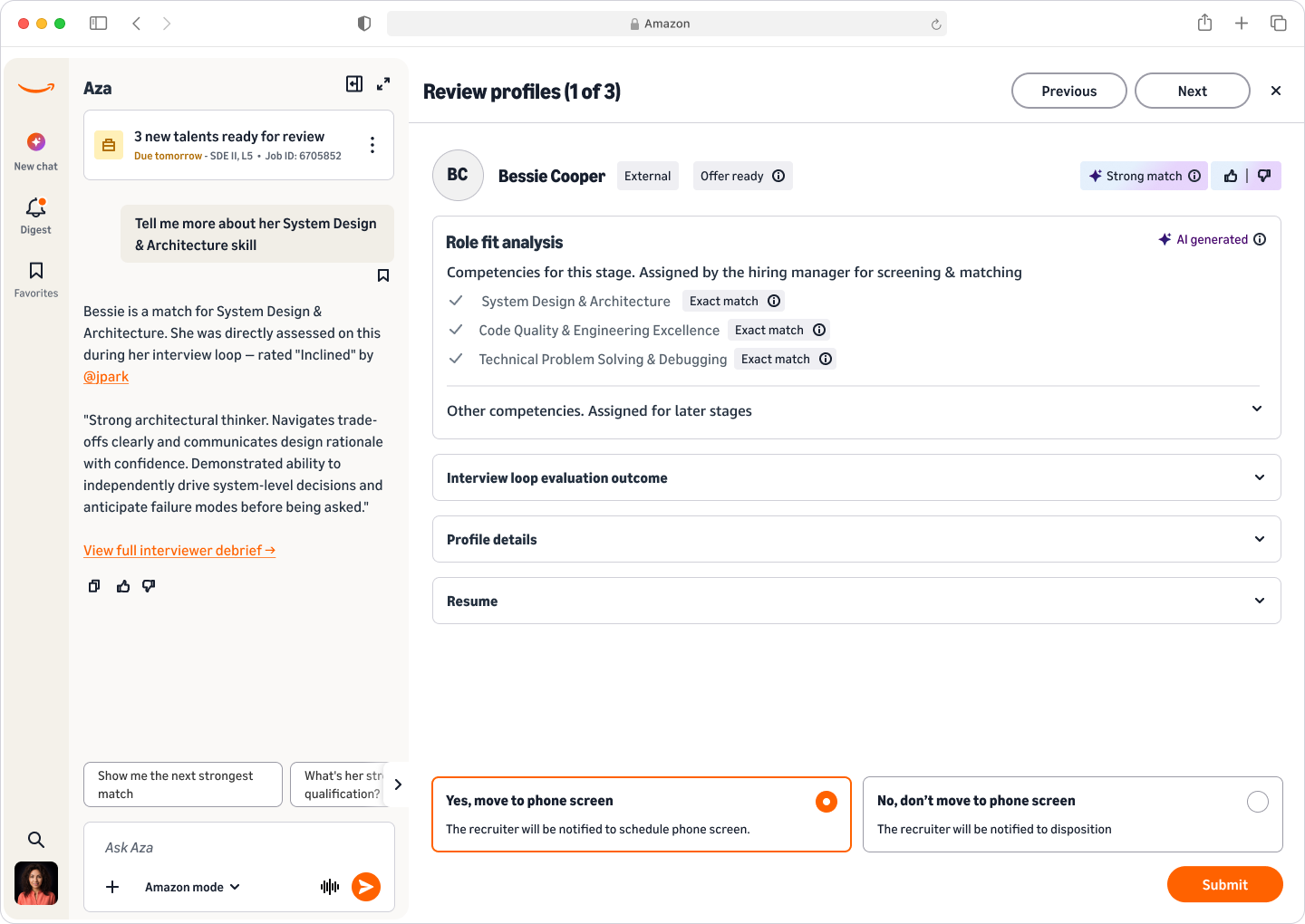
Today a manager clicks into each profile to read summaries one at a time. In the vision, they land on a prioritized view where each candidate’s strengths are summarized up front, and every summary is tied back to its source, whether an assessment or a specific piece of interview feedback. That’s what makes it trustworthy: the manager can validate what they’re reading without opening each profile to check.
Say Priya wants to understand one of a candidate’s strengths, like their system design skills. She asks in the chat, or uses a question the companion suggests, and it comes back with the supporting evidence, ties it to the interviewer feedback it came from, and maps it to the competency for the role. She can keep probing, and compare two candidates side by side: the companion shows where each one is stronger, so she doesn’t have to piece it together herself.
Internal candidate review
The experience is the same. The data is different. For an internal candidate, the information normally lives in scattered places, so today she’d be hunting it down herself. The companion pulls it together, bringing forward performance summaries, ratings, and work contributions, so she digs in exactly the same way, whether the candidate is internal or external.
The debrief decision
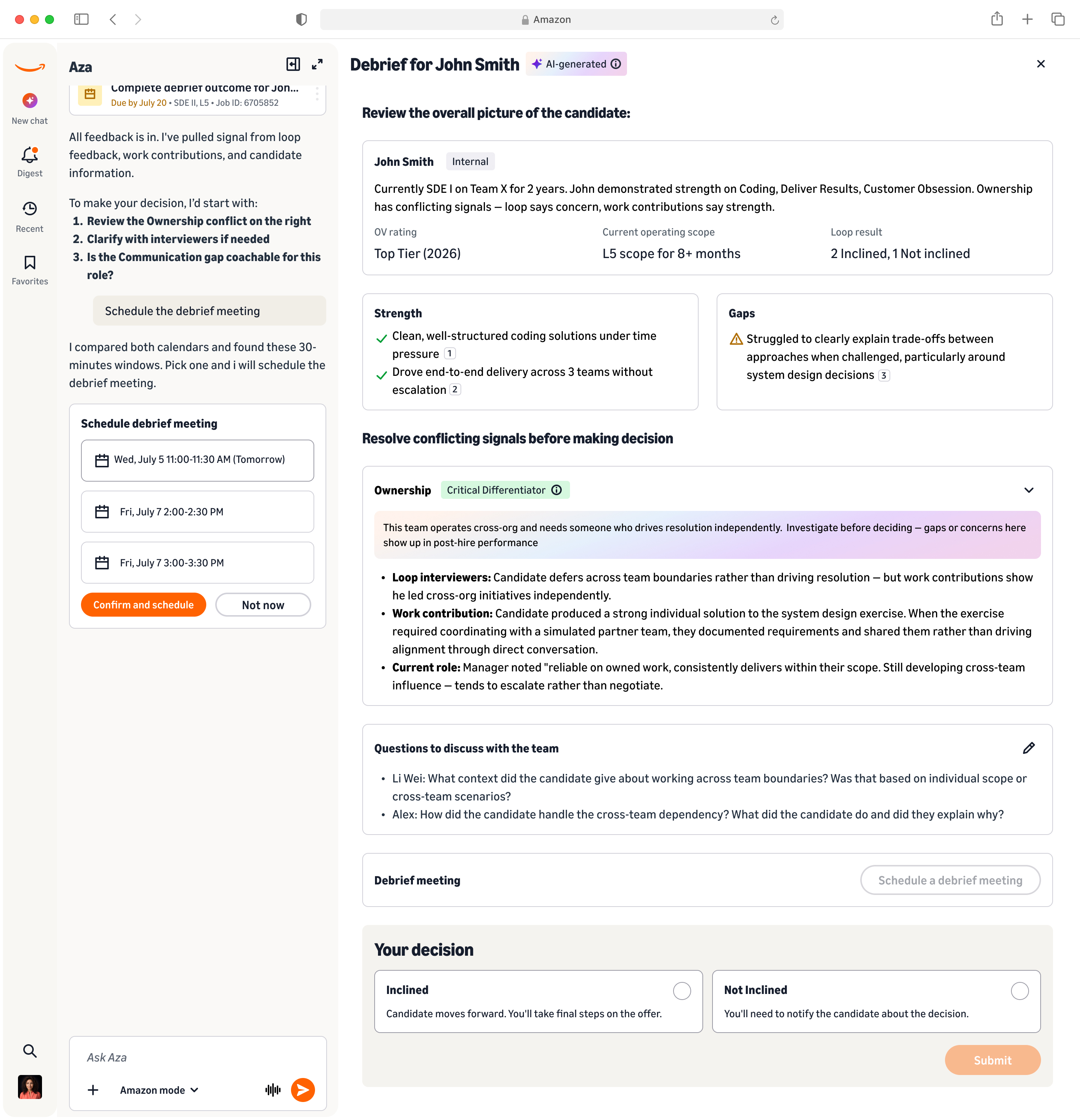
Internal debriefs have no decision support today, so managers assemble the picture by hand, reading across every interviewer’s feedback to find where the signals agree and where they don’t. The companion does that synthesis: it brings the summary, strengths, gaps, and conflicting signals into one view, and explains why a conflict matters for the role. It also handles the logistics around the decision, scheduling the debrief and turning the meeting back into editable notes, so nothing pulls the manager out of the task.
What it won’t do is the one thing that matters most. The companion never tells her whether to incline. It surfaces and explains the evidence; the judgment, and the call, stay with her.
Offer support
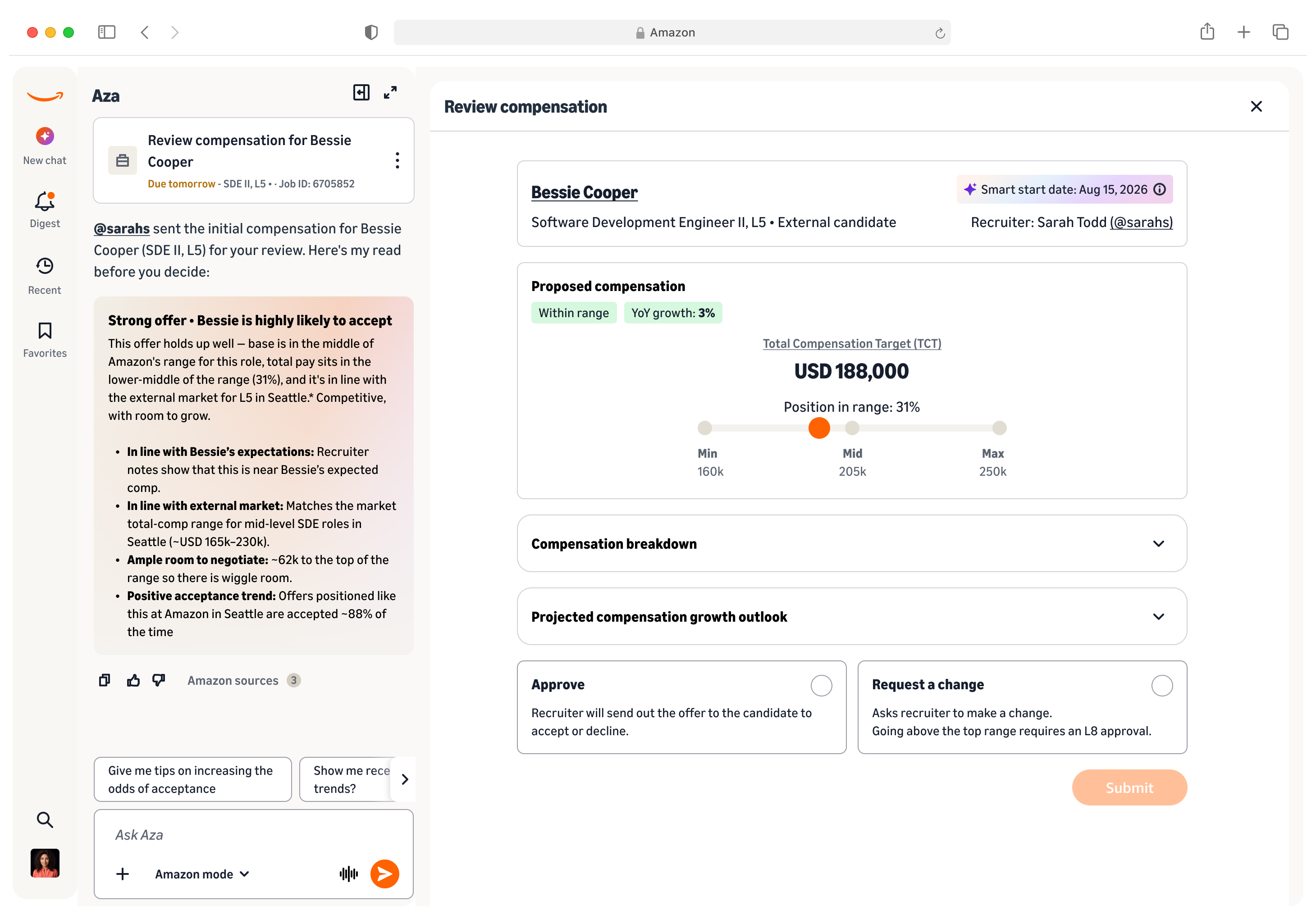
We don’t have this in Hiring Hub today, but it’s where the vision closes the loop. At the offer stage the recruiter does the legwork, but the manager approves, usually without a real read on whether the offer is competitive. The companion leads with a clear read, and if she wants to know why, she can expand the reasoning: how it compares to expectations and to the market. She can go further and ask for tips to help close the candidate. So instead of approving and hoping, she approves knowing, without having to be a comp expert herself.
Decisions and principles
A few principles shaped the model more than any single screen. Each came with a real fork, worked out with product, science, and engineering partners.
Keep the decision human
Should AI recommend an incline or decline when the signal looks clear?
The companion never recommends an outcome or rates a candidate. The moment it suggests a call, it anchors the manager’s judgment, which is the one thing we had to protect. It surfaces and explains; the person decides.
Respect how people actually think
Should managers compare internal and external candidates side by side?
Comparison stays within a candidate type, never across the two. There’s no science to support a cross-group comparison, and research showed managers already reason about internal and external candidates in separate mental models. The design follows that instead of fighting it.
Design for engagement, not checkboxes
Should candidate comparisons be a clean green-yellow-red ratings grid?
Comparisons stay as readable evidence rather than a ratings table. A grid invites checkbox thinking, while keeping the evidence in view pushes managers to actually read it, which matters more than scannability in a high-stakes call.
Those decisions rest on a few hard limits I held throughout. They’re what make the vision trustworthy:
- Outputs are grounded in visible, reviewable sources. You can always trace a claim back to where it came from.
- The companion may propose, draft, or route. It doesn’t silently change durable records.
- Cross-system actions require explicit human approval.
How I’d measure it
I defined success up front, around one question: are we helping hiring managers make more confident, higher-quality decisions with the companion? I proposed four measures spanning speed, decision quality, calibrated trust, and error recovery, each built so a gain never counts on its own.
The clearest example is the first. We’d track whether job creation, screening, and evaluation get faster, but only credit it when it’s paired with a strong quality signal, like a solid competency profile behind the decision. Speed without quality isn’t success, it’s just a faster way to get it wrong. Building that guardrail into the metric itself is the point.
These are initial measures, to be validated and refined during product definition.
Where it landed
The vision did its job. It turned a broad, ambiguous question into something real enough to interrogate, align on, and invest in. Leadership engaged with it as a plan, not a demo: the discussion went straight to feasibility, orchestration architecture, data sources, and guardrails.
It became the agreed direction for where Hiring Hub goes next, with feasibility now under active assessment with the platform and engineering teams. It kicked off a standing bi-weekly UX research bench to keep testing with real hiring managers, design reviews to resolve the open questions, and a conversation about a possible 2027 goal around offer-approval speed and quality. The near-term launch is still the core Hiring Hub experience; the companion is the next horizon, and this is what aligned the org on pursuing it.